Discover how prediction markets react to volatility, social media narratives, emotional crowd behavior, and breaking news across politics, crypto, AI, sports, and global forecasting events.
Prediction Market Psychology: Why Crowd Behavior Moves Probabilities So Fast
Prediction markets are often described as forecasting systems.
But after spending enough time watching them, they start looking just as much like psychology systems.
Probabilities move because people react.
People react because information spreads.
And information spreads emotionally online faster than ever before.
That combination creates one of the most fascinating parts of modern prediction markets:
crowd behavior becomes visible in real time.
During major election nights, crypto rallies, AI announcements, or sports finals, market probabilities sometimes swing dramatically within minutes.
Not always because reality changed instantly.
Sometimes because sentiment did.
This is one reason prediction markets attract attention far beyond traditional forecasting communities.
Many people follow them simply to watch how collective expectations evolve under pressure.
Prediction Markets Reflect Human Behavior
Prediction markets are ultimately driven by people.
And people rarely process uncertainty calmly during major events.
Online communities discussing prediction markets frequently describe moments of:
panic buying
emotional overreaction
momentum chasing
sudden reversals
narrative collapses
Especially during:
elections
crypto volatility
geopolitical crises
AI hype cycles
championship games
Markets often become emotional very quickly.
Then later, probabilities sometimes stabilize once reactions cool down.
This pattern appears repeatedly across prediction market discussions on:
Reddit
X
livestreams
financial communities
Some observers even argue that prediction markets reveal emotional crowd behavior more clearly than social media itself because probabilities force people to publicly express conviction rather than simply post opinions.
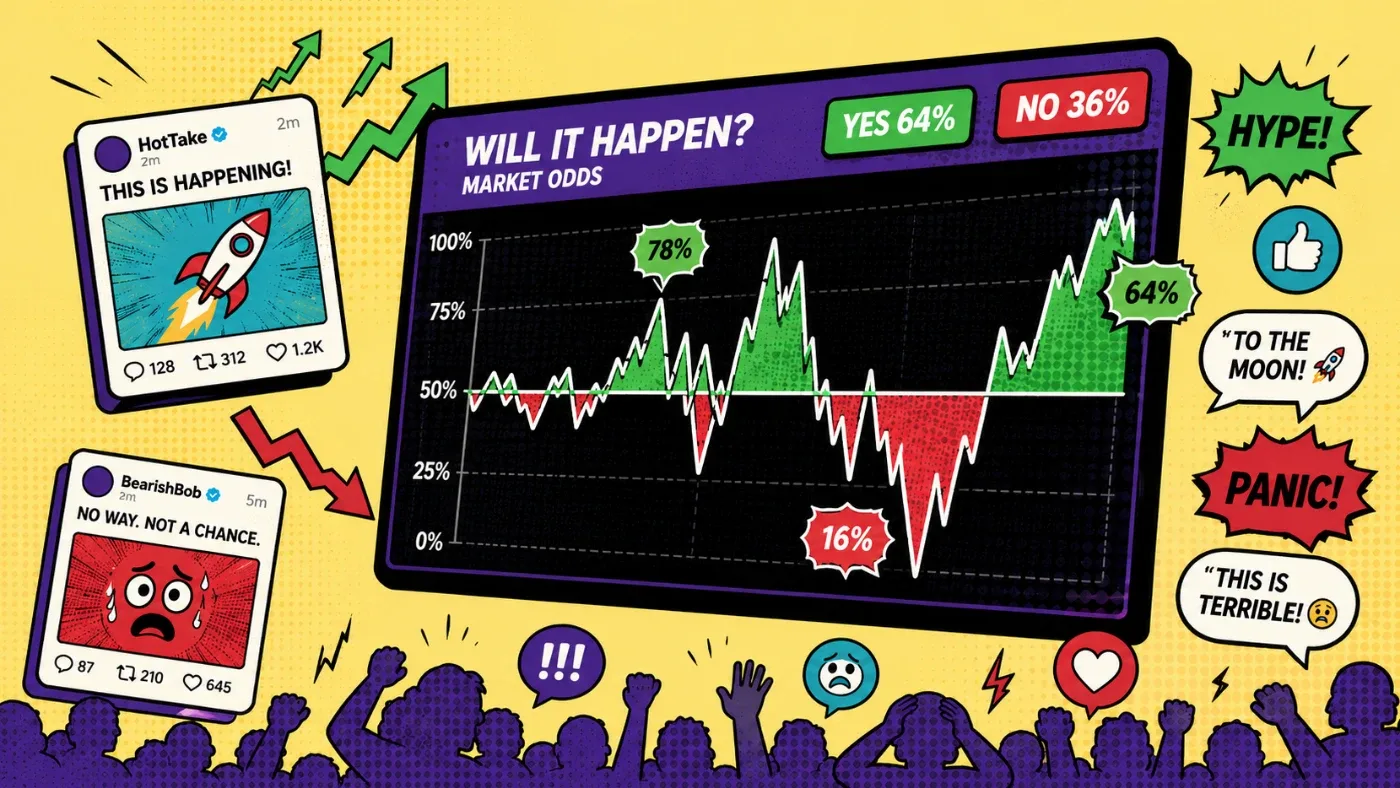
Prediction market volatility showing emotional crowd reactions and rapid probability swings
Why Probabilities Sometimes Move Faster Than Reality
One of the strangest things about prediction markets is how quickly probabilities react to headlines.
A single:
debate clip
inflation report
AI announcement
ETF rumor
sports injury
can rapidly reshape market sentiment.
Sometimes probabilities move before the broader public fully processes the information itself.
This is where the phrase:
appears constantly across market communities.
The idea is simple:
markets may react before mainstream narratives fully catch up.
But fast movement does not always mean rational movement.
Prediction markets can become highly unstable during emotional news cycles.
And online narratives often accelerate volatility further.
Social Media Has Changed Prediction Markets Completely
Modern prediction markets are deeply connected to internet culture.
Platforms like:
Reddit
X
YouTube
TikTok
livestreaming communities
now influence how quickly market sentiment spreads.
During major global events, probabilities sometimes shift almost in sync with viral narratives online.
Election nights are a perfect example.
After debates or controversial moments, prediction market discussions often explode across social platforms within minutes.
Crypto markets behave similarly after:
ETF rumors
exchange news
regulation headlines
influencer commentary
Some longtime market observers believe prediction markets have become both:
faster
and emotionally noisier
because of social media acceleration.
Viral Narratives Create Volatility
One recurring pattern visible across online prediction market communities is how quickly confidence can flip after a single viral headline or clip.
A market may suddenly become:
euphoric
fearful
convinced
uncertain
almost overnight.
Later, probabilities often partially reverse once the emotional momentum slows down.
This does not necessarily mean prediction markets are “broken.”
It simply reflects how humans collectively react to uncertainty in real time.
Prediction Markets Are Not Perfect Forecasting Systems
Prediction markets can sometimes aggregate information very efficiently.
But they are not magic forecasting machines.
Critics often point to several weaknesses:
low liquidity
emotional crowd behavior
narrative bubbles
manipulation concerns
information asymmetry
Smaller markets can become especially unstable during emotional news cycles.
And during highly polarized political events, probabilities may become heavily influenced by tribal narratives rather than objective analysis.
This is one reason some analysts treat prediction markets as:
useful signals
but not guaranteed truth
Understanding this distinction matters.
A lot.
Why People Follow Prediction Markets Even Without Trading
One interesting trend is how many people now follow prediction markets without actively participating financially.
For some users, probabilities themselves have become a form of:
live sentiment tracking
political temperature monitoring
crowd psychology observation
internet behavior analysis
Watching probabilities shift in real time during:
elections
crypto crashes
AI product launches
geopolitical conflicts
has become part of the broader online information ecosystem.
Some people never place a single trade.
They simply watch the probabilities.
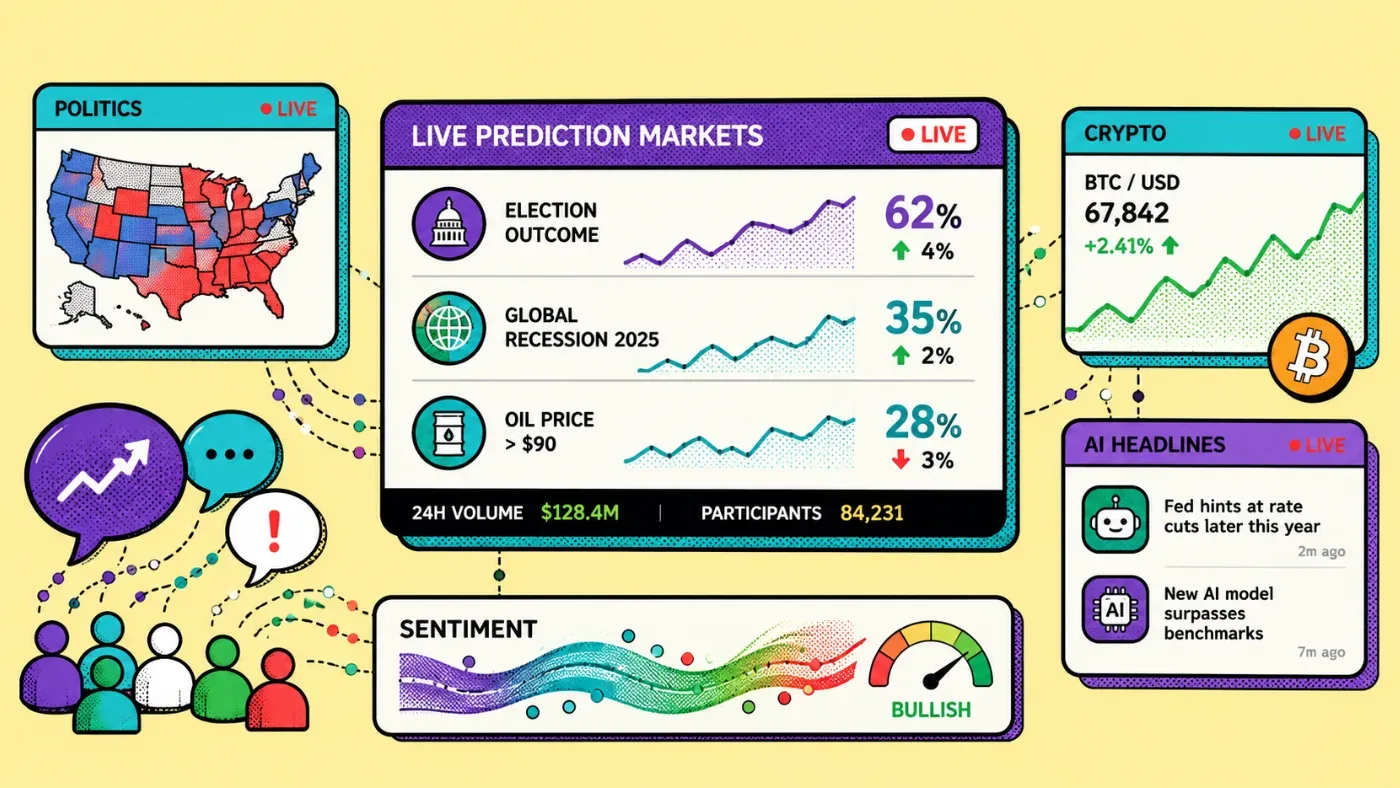
Prediction market ecosystem showing live crowd sentiment and probability movement across global events
Different Categories Behave Differently
Not all prediction markets react the same way.
Different categories develop very different emotional dynamics.
Political Markets
Political forecasting markets often become highly emotional during:
debates
scandals
election nights
geopolitical crises
Media narratives and online tribalism can strongly influence short-term probability movement.
Explore to follow election and geopolitical forecasting trends.
Crypto Markets
Crypto prediction markets are among the fastest-moving forecasting environments online.
Sentiment shifts rapidly after:
ETF news
exchange rumors
regulation changes
macroeconomic headlines
Explore to monitor blockchain and digital asset forecasting.
Technology and AI Markets
AI forecasting markets increasingly react to:
model launches
product demos
funding announcements
industry hype cycles
Explore for AI and innovation forecasting trends.
Sports and Esports Markets
Sports forecasting markets behave differently because live events directly reshape probabilities in real time.
Momentum swings become extremely visible during:
finals
playoffs
overtime situations
esports tournaments
Explore and for live tournament forecasting.
Why Prediction Markets Fascinate Researchers
Prediction markets attract attention from:
economists
political analysts
behavioral researchers
media observers
technology communities
because they combine:
forecasting
crowd psychology
information flow
social sentiment
into one visible real-time system.
Researchers have spent decades studying whether crowd-based forecasting can sometimes outperform:
polls
expert panels
traditional forecasting systems
The debate continues.
But interest in prediction markets has grown dramatically during the social media and crypto eras.
The Future of Prediction Markets
Prediction markets are evolving rapidly alongside:
AI-generated information
social media acceleration
real-time news cycles
online communities
As global information moves faster, probabilities now react faster too.
This creates both:
opportunities for better forecasting
and risks of emotional instability
Prediction markets may become increasingly important not only as forecasting tools, but also as systems for understanding how online crowds process uncertainty in real time.
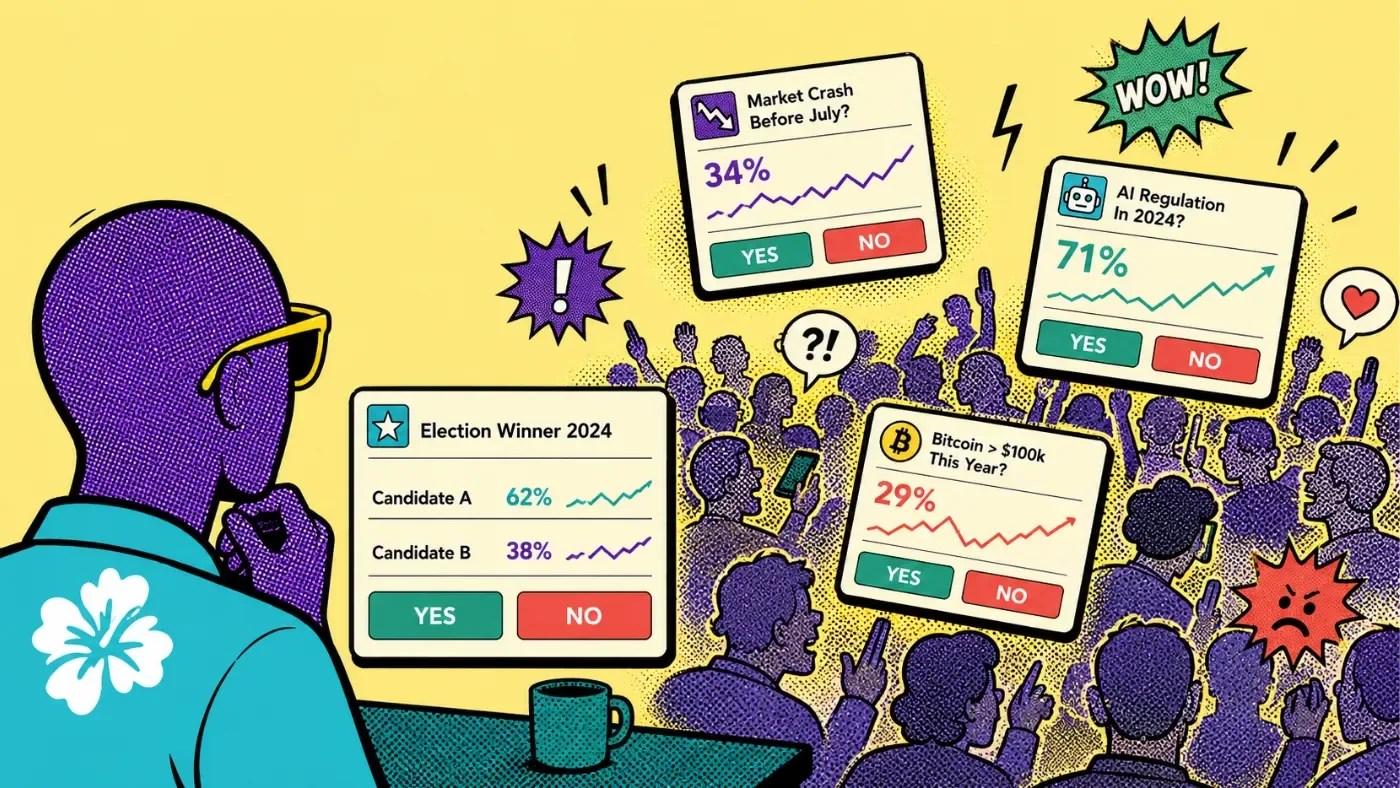
Prediction market psychology environment showing emotional crowd behavior and real-time forecasting systems
FAQ About Prediction Market Psychology
Why do prediction markets become emotional?
Prediction markets react quickly to uncertainty, breaking news, and social media sentiment, which can amplify crowd psychology.
Can prediction markets overreact to headlines?
Yes. Probabilities sometimes move aggressively after viral narratives or emotional news cycles before partially stabilizing later.
Are prediction markets always accurate?
No. Prediction markets can sometimes become distorted by low liquidity, emotional behavior, or narrative-driven momentum.
Why do people watch prediction markets without trading?
Many users follow prediction markets as a form of live sentiment tracking and crowd behavior observation.
What influences prediction market probabilities the most?
Major influences include:
🔵 breaking news
🔵 social media sentiment
🔵 political developments
🔵 economic events
🔵 emotional crowd reactions
Final Thoughts
Prediction markets are not only forecasting systems.
They are also real-time reflections of:
crowd psychology
online narratives
emotional momentum
collective uncertainty
That is part of what makes them so compelling to watch.
As politics, crypto, AI, finance, sports, and global events become increasingly connected to social media and real-time information flow, prediction markets are evolving into one of the internet’s most fascinating public sentiment systems.